
Cantilever Rack Systems in Washington, DC
Quality cantilever rack supplied and installed by DC Metro's trusted warehouse solutions team.
Ready to get started? Get a free, no-obligation quote today.
Long-load storage with no front column — structural and roll-formed arms up to 72 inches, for lumber, pipe, steel, and rolled goods.
About Cantilever Rack
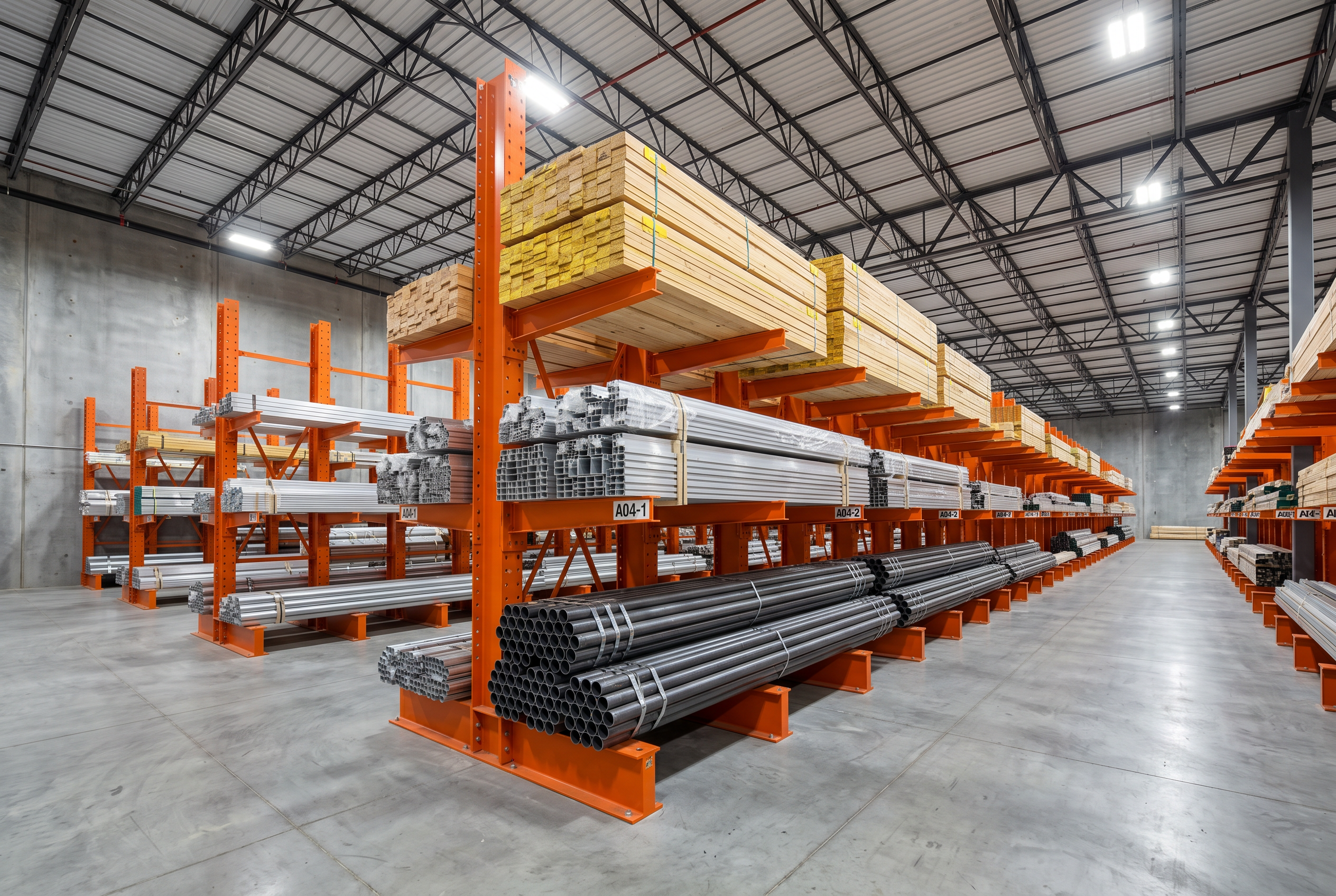
Cantilever rack is the purpose-built storage system for long loads — material that is longer than a standard pallet and often cannot be palletized at all. A cantilever system uses vertical columns with horizontal arms extending outward; because there is no front column obstructing the load face, lumber packs, pipe bundles, steel bar, tubing, rolled goods, and oversize fabricated parts sit cleanly across the arms at any length. Arms can be single-sided (against a wall) or double-sided (freestanding, loaded from both sides for density). Arm capacities scale from 500 lbs per pair on light-duty roll-formed systems up to 4,000+ lbs per pair on structural-steel systems. Cantilever is the default rack for DC metro plumbing wholesalers, Baltimore-area steel service centers, lumber and building-supply distributors across Maryland and Northern Virginia, HVAC distribution, and furniture and oversize-part operations. DC Pallet Racking designs, supplies, and installs cantilever systems engineered to IBC 2021 (DC, MD, VA amendments) and RMI ANSI MH16.1-2023, with base shoes anchored to code for wind and lateral loading across the region.
How Cantilever Rack Works
The mechanics behind the system — and why they matter for your operation.
Vertical columns, horizontal arms
Structural steel columns (I-beam or heavy tube) are base-shoe-anchored to concrete. Horizontal arms bolt into the column at set elevations, extending forward 24 to 72 inches to cradle the load.
No front obstruction
Because there is no front column, the load face is completely open. A 24-foot length of pipe or lumber sits across multiple arms without the interference a selective rack beam would create.
Side-load from the aisle
A lift truck with long forks or a side-loader positions parallel to the rack and sets the load across the arms. The truck never enters the rack — all handling is aisle-side.
Single-sided or double-sided
Single-sided cantilever backs up to a wall or column line. Double-sided cantilever is freestanding with arms on both sides — doubling the linear storage in the same column footprint.
When to Choose Cantilever Rack
- • You store loads longer than 48 inches (pipe, lumber, bar stock, rolled goods, extrusions)
- • Product cannot be palletized or palletizing wastes significant space
- • You need to pull bundles or pieces from a load at mixed lengths
- • Current pallet rack is forcing you to stack long loads inefficiently across multiple bays
- • You want the density advantage of double-sided long-load storage
When Not to Choose
- • Loads fit cleanly on standard pallets — stay with selective pallet rack
- • You need overhead density with only short items — pallet rack or shelving is more space-efficient
- • You need full enclosure for security — cantilever is inherently open-faced
- • Your load capacity per arm exceeds 4,000 lbs — specialty heavy-structural designs or alternative storage needed
Specifications at a Glance
- Column height
- 8 to 25 feet
- Arm length
- 24 to 72 inches (standard); custom to 96 inches
- Arm capacity
- 500 lbs (light-duty) to 4,000+ lbs (heavy-structural) per arm pair
- Construction
- Structural I-beam steel or roll-formed heavy-gauge
- Configuration
- Single-sided (wall-backed) or double-sided (freestanding)
- Arm options
- Straight, incline, with end stops, with rub rails, with dividers
- Base
- Steel base shoe anchored to concrete per engineered drawings
- Column spacing
- 4 to 10 feet typical (load-length dependent)
- Code compliance
- IBC 2021 (DC, MD, VA amendments), RMI ANSI MH16.1-2023
- DC metro seismic / wind
- SDC A–B, wind per ASCE 7 (115 mph 3-sec gust typical) — anchoring sized accordingly
Cantilever vs. Alternatives for Long-Load Storage
| Attribute | Cantilever | Selective Pallet Rack | Bulk Floor Storage |
|---|---|---|---|
| Max load length | Effectively unlimited | 48" typical | Unlimited but inefficient |
| Load shape compatibility | Long, irregular, non-pallet | Palletized only | Any, but stacks unstably |
| Space efficiency for long loads | High | Poor (wastes beam spans) | Lowest |
| Forklift access | Side-load, never enters rack | Standard, never enters rack | All sides, limited stacking |
| Damage exposure | Low | Low | High (bundles shift, crush) |
| Vertical cube utilization | Excellent | Excellent (short loads) | Poor |
| Configuration | Single or double-sided | Single or back-to-back | Floor only |
| Relative cost per linear ft | $$ | $ (if load fits) / $$$ (if load spans bays) | $ (free) |
Where Cantilever Rack Fits in the DC Metro
Specific industries across DC, Maryland, and Northern Virginia where this system pays off.
Plumbing & PVF wholesale — Beltsville, Baltimore, Sterling
Ferguson Enterprises has deep DC metro presence and relies on cantilever for bulk pipe, fittings stock rod, and tubing. Winsupply and CED electrical wholesale operations use the same pattern for conduit and long-length electrical stock.
Lumber & building supply — across DC, MD, and VA
84 Lumber Hagerstown, Home Depot RDC (Frederick / Winchester), Lowe's regional operations, and Carter Lumber run cantilever for dimensional lumber, treated lumber, engineered wood products, and trim packs — double-sided configurations common in larger yards.
Steel service centers — Baltimore, Fredericksburg, Sparrows Point
Metals USA, Triple-S Steel (Fredericksburg VA), and the Baltimore-area service centers anchored around the Port of Baltimore store structural shapes, bar stock, flat bar, and tubing on heavy-structural cantilever. These are the heaviest-duty DC metro cantilever installs — 3,000 to 4,000 lbs per arm pair is routine.
HVAC distribution — Sterling, Beltsville, Baltimore
Ferguson HVAC, Johnstone Supply, and regional Trane and Lennox distribution run cantilever for sheet-metal ductwork stock, line sets, and long-format refrigerant tubing where palletizing would waste vertical cube.
Furniture & oversize retail — Manassas, Hanover, Bowie
Havertys (Manassas), Ethan Allen regional operations, and regional furniture DCs use cantilever for rolled carpet, bundled headboards, long mattress packaging, and oversize furniture components that exceed pallet dimensions in every direction.
Product Features
- Column heights from 8 to 25 feet for single or multi-level storage
- Arm lengths from 24 to 72 inches with custom options to 96"
- Light-duty roll-formed through heavy-structural I-beam constructions
- Single-sided (wall-backed) and double-sided freestanding configurations
- End stops, incline arms, rub rails, and divider options available
- Base shoes anchored per engineered drawings for DC metro wind loading
- Engineered to IBC 2021 (DC, MD, VA amendments) and RMI ANSI MH16.1-2023
Benefits for Your Business
Frequently Asked Questions
Real answers for buyers researching cantilever rack in the DC metro area.
What is the difference between roll-formed and structural cantilever?
Can cantilever be moved or reconfigured?
Do I need seismic or wind engineering in the DC metro area?
How do I choose arm length?
Can I mix cantilever arm levels for different products?
Is single-sided or double-sided cantilever better?
Related Services
We don't just supply — we design, install, inspect, and maintain.
Get a Free Quote
Contact us today for a no-obligation quote on cantilever rack for your DC metro facility.
Request Free Quote (240) 540-4372Free, no-obligation quotes
Professional installation available
Licensed & fully insured
Serving all DC metro areas
Ready to Optimize Your Warehouse?
Get a free estimate from DC Metro's warehouse racking experts. We serve warehouses of all sizes throughout the Washington, DC metro area.