Repair or Replace Damaged Pallet Racking in the DC Metro Area?
10 min read · May 2026 · DC Pallet Racking Team
A forklift clips an upright column. A pallet lands wrong and bends a beam. You've seen the damage — now you need to decide: repair it, replace it, or take the whole bay out of service? This decision has real cost, safety, and liability implications for DC Metro warehouse operators, and making it correctly requires understanding both the engineering standard and the jurisdiction-specific documentation requirements that apply in DC, Maryland, and Virginia.
Critical Safety Note
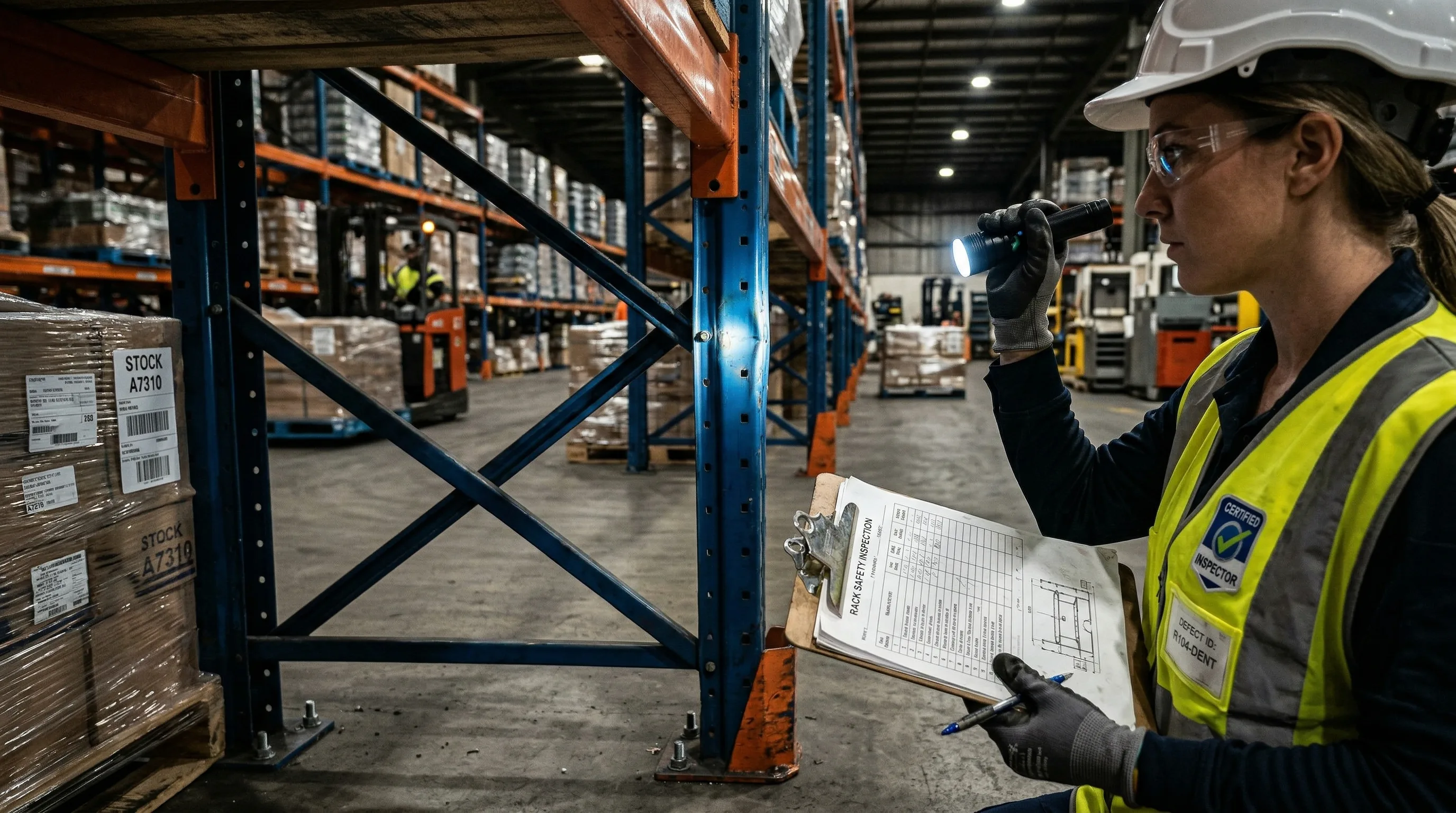
Damaged rack must be taken out of service immediately and kept unloaded until a qualified professional makes the repair or replace determination. Never continue to use visibly damaged racking. DC Pallet Racking provides emergency rack inspection and repair throughout the DC Metro area, typically same-day or next-day response.
The ANSI/RMI Damage Classification System
ANSI/RMI MH16.1 — the industry standard for industrial storage racks — establishes a three-tier damage classification system that is the foundation of any repair-or-replace decision. Understanding this system is the first step for any warehouse manager dealing with damaged racking.
Green: Serviceable
Green-classified damage is minor surface damage — paint chips, minor scratches, superficial rust — that does not affect the structural integrity of the component. Green-tagged rack can remain in service without repair. However, components that appear green today can deteriorate to yellow or red if surface damage allows corrosion to progress, particularly in facilities near the Potomac or in the high-humidity environments common in suburban Maryland and DC proper. Green-tagged components should be monitored at each inspection cycle.
Yellow: Damaged — Evaluation Required
Yellow classification covers damage that may or may not compromise the component's capacity, depending on the severity and location. Yellow-tagged components must be evaluated by a qualified racking engineer or inspector before a continue/repair/replace decision can be made. The component must be unloaded during the evaluation period. Yellow damage includes:
- Minor bends in upright columns (less than 1/2 inch lateral deflection in any 10-foot section, per ANSI/RMI guidance)
- Dented column faces where no perforations are affected
- Bent beams with no cracking at connectors
- Damaged but structurally intact base plates
- Missing beam safety clips (the bay must be unloaded until clips are reinstalled)
Red: Remove from Service Immediately
Red classification means the component is unsafe to load under any circumstances. The bay must be completely unloaded and blocked off until the damaged component is replaced or the system is professionally repaired. Red damage includes:
- Upright column bends exceeding 1/2 inch in any 10-foot section
- Any crack or tear in an upright column or beam
- Buckled upright columns (visible kinking or warping)
- Severely damaged or missing base plates
- Any damage at or near a weld point on beams or connectors
- Upright columns that are visibly out of plumb (leaning)
- Any upright column that has been struck hard enough to shear an anchor bolt
When Repair Is Acceptable — and When It Isn't
The repair-vs-replace question is not purely a damage severity question — it also depends on what type of component is damaged and what repair method is proposed.
Repairs That Are Generally Acceptable
- Column guard installation: Adding a column guard or upright protector to a mildly damaged lower column section is a legitimate repair for yellow-classified base damage, provided the column itself remains structurally sound above the damaged area.
- Base plate repair or replacement: A corroded or lightly bent base plate can often be replaced without replacing the entire upright. This requires unloading the affected bay and safely transferring the column load while the new base plate is installed and anchored.
- Beam connector replacement: Damaged beam-end connectors can sometimes be replaced if the beam body is undamaged, provided the replacement connectors are OEM or certified-equivalent components from the same manufacturer.
- Beam safety clip reinstallation: Missing or dislodged safety clips are a straightforward repair — simply reinstall the correct clip for that beam/upright combination. Never substitute a clip from a different manufacturer or product line.
Repairs That Are NOT Acceptable
- Straightening bent upright columns: Field-straightening a bent column using a torch or hydraulic jack is not an acceptable repair under ANSI/RMI. The column has been plastically deformed and its yield properties are compromised. Replace it.
- Welding cracks in columns or beams: Welding on load-bearing structural components in the field is not acceptable without engineering review and must be performed by a certified welder per an engineered repair procedure. In most cases, replacement is faster and less expensive.
- Using aftermarket column repair kits not certified for that specific rack: Bolt-on repair sleeves and column repair kits are available from various suppliers. Some are legitimate engineered products certified for specific rack brands and damage conditions. Many are not. Using an uncertified repair kit does not restore the column's rated capacity and creates liability exposure.
Cost Framework: Repair vs. Replacement
The cost comparison between repairing and replacing damaged rack components in the DC Metro market (as of 2026) typically looks like this:
- Column replacement (single upright frame): $400–$900 for the component plus $300–$600 for labor, including unloading the bay, swapping the upright, re-anchoring, and reloading. Total: $700–$1,500 per upright frame.
- Beam replacement: $80–$250 per beam depending on size and manufacturer, plus $75–$150 labor per beam. Total: $155–$400 per beam.
- Column guard installation (retroactive protection): $150–$300 per column position including hardware and installation. This is almost always the most cost-effective follow-on investment after any upright impact event.
- Full bay rebuild (new uprights + new beams): $1,200–$2,500 per bay depending on height and configuration. This is often the right answer when an older system has accumulated multiple yellow-category damages across several bays — cumulative replacement cost approaches new installation cost.
When your rack is 15+ years old and has had multiple prior repair cycles, a complete replacement section is often more cost-effective than continued component-by-component repairs — and provides a clean, fully documented load rating rather than a patchwork system with uncertain cumulative capacity.
DC, Maryland, and Virginia: Documentation and Liability Differences
The three DC Metro jurisdictions have different requirements around rack damage documentation, and these differences matter for your liability exposure and insurance coverage.
Washington DC
DC OSHA operates its own state-plan program and has been increasing enforcement activity in warehouse settings. For any rack incident involving a near-miss, injury, or significant product damage, DC OSHA expects the employer to be able to document the incident, the immediate corrective action taken (unloading the bay), and the subsequent repair/replace action with professional documentation. Facilities that cannot produce inspection records or repair documentation are more vulnerable to citation under the General Duty Clause.
Maryland
Maryland OSHA (MOSH) follows federal OSHA standards with some state-specific additions. Montgomery and Prince George's counties — which host significant warehouse density — have active code enforcement. Maryland courts have generally been plaintiff-favorable in warehouse injury litigation, which means written rack maintenance records and documented repair/replace decisions are important not just for OSHA compliance but for civil liability defense.
Virginia (VOSH)
Virginia operates its own OSHA program (VOSH) and has been active in warehouse enforcement in the Northern Virginia logistics corridor. Fairfax and Prince William counties have both seen increased commercial building inspection activity as the region's warehouse footprint has grown. VOSH has the authority to require records of rack inspections and maintenance actions. Virginia also requires that rack installations above certain thresholds obtain building permits — and unpermitted installations that are subsequently found to have damage can face additional code enforcement action beyond the OSHA citation.
Insurance Documentation: What Your Carrier Actually Wants
Most commercial property and general liability policies covering DC Metro warehouses include provisions that require the insured to maintain equipment in a safe and serviceable condition. A rack collapse that results in a workers' compensation claim or third-party liability action will trigger a coverage review — and if the insured cannot demonstrate that damaged rack was identified and addressed promptly, coverage denial or reduction is a real possibility.
The documentation your insurance carrier wants to see:
- Annual professional rack inspection reports with component-level condition ratings
- Records of any impact incidents, including date, location, immediate action taken, and professional assessment outcome
- Repair or replacement work orders with the contractor's documentation of what was done and the post-repair condition
- Updated load placards reflecting any changes to the system after repair or component replacement
DC Pallet Racking's rack inspection and repair service provides all of this documentation as standard deliverables — inspection reports, repair work orders, and updated load placard recommendations — in a format that satisfies both OSHA and insurance documentation requirements. For full system repairs or replacements requiring permits, our installation team handles the permit process in all three DC Metro jurisdictions. Call us at (240) 540-4372 for same-week scheduling.
Damaged Rack? Get a Professional Assessment
We provide same-day and next-day rack damage assessments throughout Washington DC, Northern Virginia, and suburban Maryland — with written reports for OSHA and insurance documentation.
Schedule an Emergency InspectionReady to Optimize Your Warehouse?
Get a free estimate from DC Metro's warehouse racking experts. We serve warehouses of all sizes throughout the Washington, DC metro area.