
Pallet Rack Load Capacity: What DC Metro Warehouse Managers Must Know
9 min read · May 2026 · DC Pallet Racking Team
Load capacity is the number that keeps warehouse managers up at night — and for good reason. Overloaded racking is one of the leading causes of rack collapse, OSHA citations, and warehouse liability claims across the DC Metro area. But understanding what that number actually means, where it comes from, and what can change it is more nuanced than most operators realize.
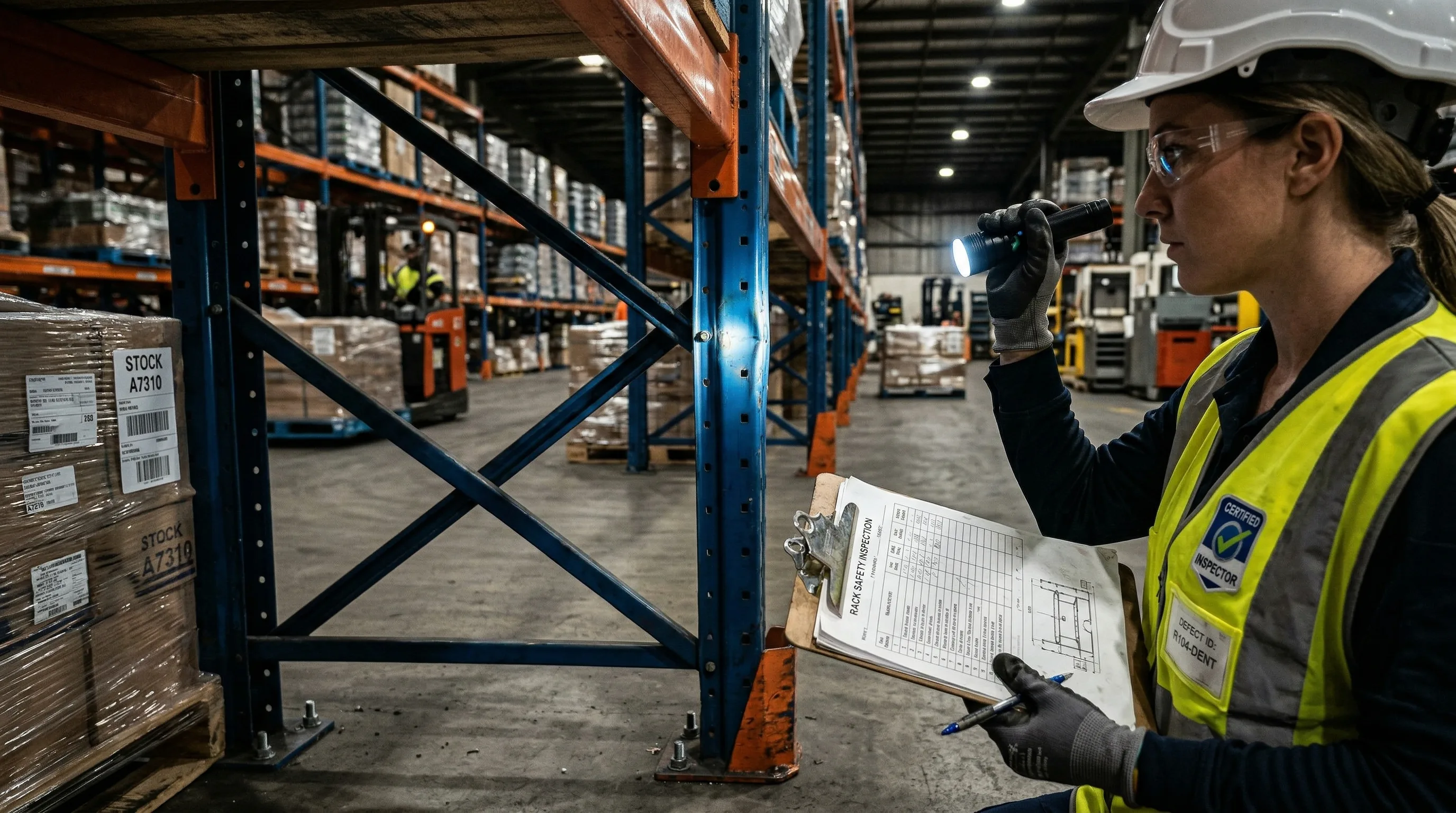
Important Note
This article is for informational purposes. Load capacity determinations for your specific racking system should be performed by a qualified racking engineer. DC Pallet Racking offers professional rack inspections and engineering and permitting services throughout the DC Metro area.
The Two Numbers Every Warehouse Manager Needs to Know
Pallet racking has two distinct load ratings, and confusing them is a common and dangerous mistake:
- Beam capacity — the maximum uniformly distributed load a single pair of beams can support. Typically expressed in pounds per beam level.
- Upright (frame) capacity — the maximum total load the entire upright column assembly can carry, including every level stacked on top of it.
Both numbers must appear on the load placard posted at the end of each rack row. If your placards only show one figure, or if the placards are missing entirely, you have a compliance gap that needs to be corrected immediately. Under 29 CFR 1910.176(e), load capacity posting is a mandatory OSHA requirement — not a recommendation.
What Actually Determines Load Capacity
The number on the placard is not arbitrary — it comes from a combination of engineering factors specific to your rack system:
- Beam gauge and section profile — heavier gauge steel and deeper beam profiles increase capacity. A 4-inch beam and a 6-inch beam of the same length can have dramatically different ratings.
- Beam span (bay width) — longer spans deflect more under load. A beam spanning 96 inches carries less than the same beam spanning 72 inches, even though the beam itself is identical.
- Upright column gauge and height — taller uprights are more susceptible to column buckling under compression. A 20-foot upright has a lower per-level capacity than an identical 12-foot upright.
- Column base plate and anchor bolt condition — base plates transfer load to the floor slab. Corroded, cracked, or missing base plate anchors reduce the effective capacity of the entire upright.
- Diagonal bracing configuration — the brace pattern in the frame determines how lateral loads (forklift impacts, seismic forces) are handled. Damaged or missing bracing can cut capacity significantly.
- Floor slab capacity — in older DC Metro industrial buildings, particularly in DC proper and parts of suburban Maryland, floor slab thickness and condition can be a limiting factor before the rack itself becomes the constraint.
Beam Deflection: The Visible Warning Sign You Shouldn't Ignore
When a beam is loaded, it deflects — it bends slightly under the weight. Some deflection is normal and engineered into the design. Too much deflection is a warning that the beam is approaching or exceeding its capacity.
ANSI/RMI MH16.1 sets the acceptable deflection limit at span/180. For a 96-inch (8-foot) beam span, that's a maximum allowable deflection of 0.53 inches. For a 144-inch (12-foot) span, the limit is 0.80 inches.
In practice, if you can visibly see a beam sagging under load — if it looks bowed when you stand at the end of the aisle and look down the row — that's already a problem. Visibly sagging beams should be unloaded and inspected immediately. DC Metro warehouses that handle heavy industrial supplies, government surplus equipment, or dense consumer goods are particularly susceptible to beam overload on older racking systems.
Column Base Plates: The Most Overlooked Load Capacity Factor
In our experience inspecting warehouses across Washington DC, Northern Virginia, and suburban Maryland, base plate condition is the single most overlooked factor in load capacity assessment. Base plates do several things:
- They distribute the concentrated column load across a larger area of the concrete slab
- They provide the connection point for anchor bolts that resist overturning
- They protect the bottom of the upright column from moisture and corrosion at floor level
In older DC Metro warehouse buildings — particularly those in DC proper and Prince George's County that date to the 1970s and 1980s — we frequently find base plates that are corroded through, anchor bolts that are missing or sheared off, or base plates that were never properly grouted to the slab. Any of these conditions changes the effective load capacity of the system, regardless of what the original placard says.
If your building has any history of flooding, water intrusion, or if the facility is near the Potomac or Anacostia drainage basins, base plate condition deserves immediate attention.
How Load Distribution Affects Capacity
The load capacity rating assumes loads are evenly distributed across the beam level. Real-world loading rarely matches that assumption perfectly, and the difference matters:
- Concentrated loads — a single heavy pallet centered on two beams creates a point load rather than a distributed load. Point loads are more stressful to beams than distributed loads of the same total weight.
- Off-center loading — when forklifts place pallets unevenly or only partially on the beam shelf, the load eccentricity can create torsional stress on the beam.
- Deck vs. no deck — wire decking or wood deck panels spread load across the beam more evenly, often allowing higher effective storage weight than bare beams with individual pallet runners.
For DC Metro warehouses storing a mix of product types — a common situation in fulfillment operations in Landover, Jessup, and the Route 1 corridor — load variation between levels and bays should be factored into your capacity planning.
When Your Original Load Placard No Longer Applies
A load placard that was accurate when your racking was installed may no longer reflect the actual safe capacity of your system. Several conditions can invalidate the original rating:
- Any beam or upright that has been repaired or replaced with a component from a different manufacturer or gauge
- Any damage to upright columns, even if the column was not replaced (a bent column has reduced capacity)
- Addition of beam levels that weren't in the original engineering design
- Changes in the height of beam levels (raising or lowering beams changes the column effective length and therefore the column capacity)
- Removal of cross-aisle ties or row spacers
- Any seismic event — minor earthquakes are uncommon but not unheard of in the DC Metro area, and even minor ground movement can shift rack alignment
If any of these conditions apply to your system, the original placard should be treated as potentially inaccurate until a qualified engineer re-evaluates the system. Our rack inspection team can assess current capacity and update your load documentation accordingly.
Getting a Load Capacity Evaluation in the DC Metro Area
If you're unsure whether your racking is properly rated, or if your load placards are missing, damaged, or outdated, the correct path is a professional evaluation by a licensed engineer. In the DC Metro area, this means working with a PE licensed in the jurisdiction where your facility is located — DC, Maryland, or Virginia each have their own licensing requirements.
DC Pallet Racking's engineering and permitting services include load capacity evaluations, placard preparation, and the engineering documentation required for building permits in all three jurisdictions. We can also handle the permit submission process for new rack installations that require local building department approval — a requirement that applies in DC proper and many suburban Maryland and Northern Virginia municipalities.
Call us at (240) 540-4372 to schedule an evaluation at your DC Metro warehouse.
Get a Load Capacity Evaluation
We provide engineering evaluations, updated load placards, and permit documentation for warehouses throughout Washington DC, Northern Virginia, and suburban Maryland.
Schedule an EvaluationReady to Optimize Your Warehouse?
Get a free estimate from DC Metro's warehouse racking experts. We serve warehouses of all sizes throughout the Washington, DC metro area.