OSHA Pallet Racking Requirements: What DC Metro Warehouse Operators Need to Know
10 min read · March 2026 · DC Pallet Racking Team
Racking collapses kill and injure warehouse workers every year — and OSHA citations for rack-related violations carry fines that can reach into the tens of thousands of dollars. This guide breaks down exactly what OSHA requires for pallet racking in DC Metro warehouses, and what you need to do to stay compliant.
Important Note
This article is for informational purposes. For a formal compliance review of your specific facility, consult a qualified racking engineer or safety professional. DC Pallet Racking offers professional racking inspections for DC Metro area warehouses.
Does OSHA Have a Specific Pallet Racking Standard?
No — and this surprises a lot of warehouse operators. OSHA does not have a single dedicated standard for industrial storage racks. Instead, racking compliance is covered by several overlapping regulations:
- 29 CFR 1910.176 — Material handling and storage (the primary OSHA standard for warehouse storage)
- 29 CFR 1910.22 — General workplace safety (walking-working surfaces, aisle clearances)
- 29 CFR 1910.147 — Control of hazardous energy (relevant during rack maintenance)
- ANSI/RMI MH16.1 — The industry standard for rack design, incorporated by reference in many OSHA enforcement actions
When OSHA inspects a warehouse and finds a rack-related hazard, they typically cite the General Duty Clause (Section 5(a)(1)) — which requires employers to provide a workplace free from recognized hazards — alongside the specific 1910.176 requirements.
Key OSHA Requirements for Pallet Racking
1. Load Capacity Posting (Required)
This is one of the most commonly cited violations. Under 29 CFR 1910.176(e), racks must have the maximum safe load posted and visible to operators. Specifically:
- Each rack bay must display its maximum load capacity
- The placard must be legible and placed where forklift operators can see it
- Load capacities must be determined by the rack manufacturer or a qualified engineer
If you're using used racking without documentation, you cannot legally post load ratings without having the system evaluated by a qualified engineer. DC Pallet Racking provides engineering evaluations that include load capacity certifications.
2. Damaged Rack Must Be Taken Out of Service
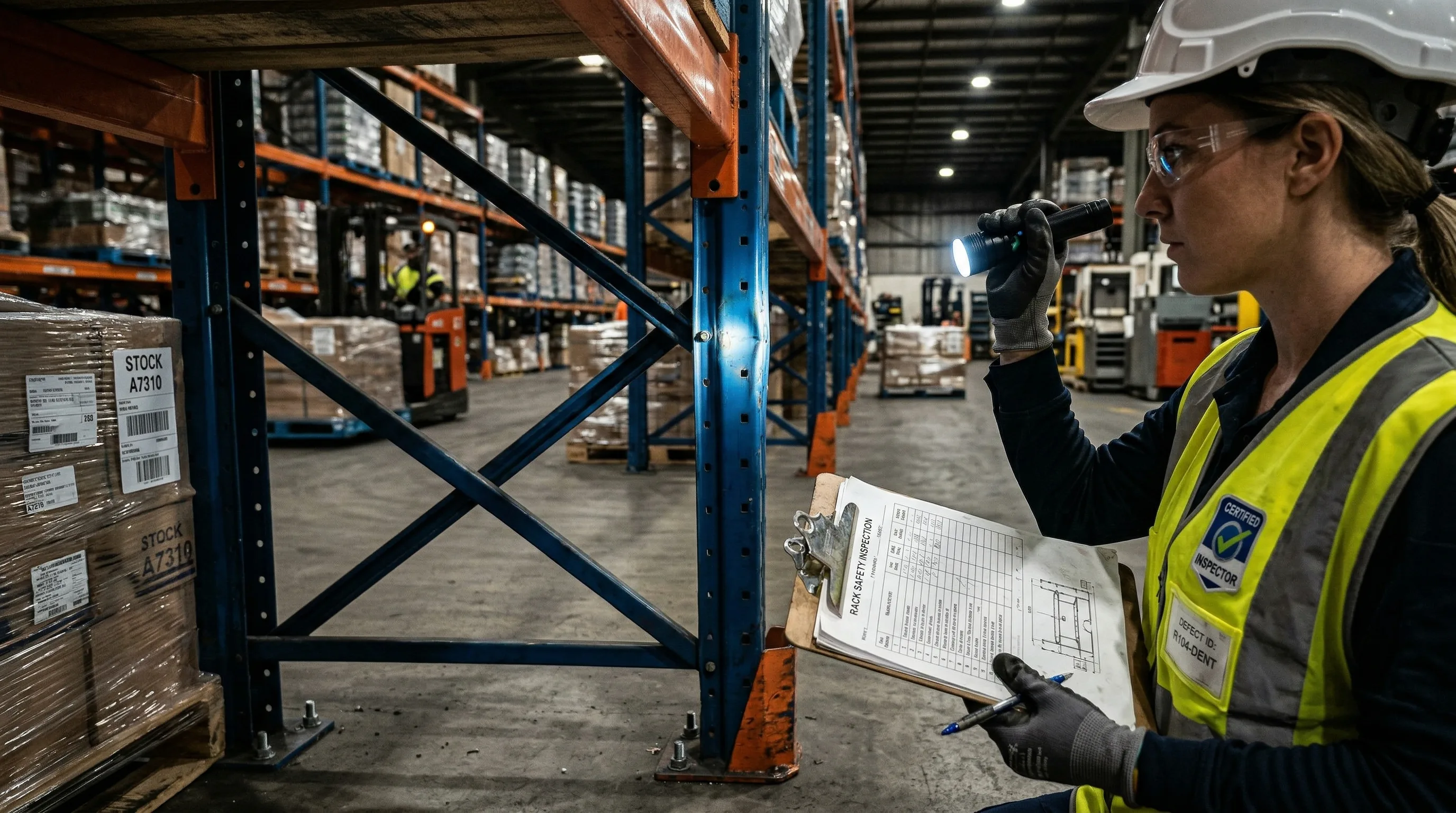
OSHA requires that damaged rack components be identified and removed from service immediately. This is not a "monitor and fix later" situation. Under the General Duty Clause, continuing to use visibly damaged racking constitutes a recognized hazard.
Common damage that requires immediate action:
- Bent or buckled upright columns
- Cracked welds at beam-to-upright connections
- Missing or damaged column base plates
- Dislodged or incorrectly seated beam safety clips
- Missing row spacers or cross-aisle bracing
If you spot damage, offload that section immediately and mark it out of service until it's repaired by a qualified technician. Our team handles emergency rack repair throughout the DC Metro area.
3. Aisle Width Requirements
29 CFR 1910.22 and 1910.178 set minimum aisle widths based on the equipment operating in them. At minimum:
- Aisles used by forklifts must be at least 3 feet wider than the widest vehicle or load
- Pedestrian aisles must be at least 28 inches wide
- Aisles must be clearly marked with floor markings or signage
4. Rack Anchoring and Floor Attachment
ANSI/RMI MH16.1 — which OSHA inspectors use as the reference standard — requires that all rack uprights be anchored to the floor. This is non-negotiable, even for "temporary" installations. Unanchored racking is one of the most common reasons racks tip during forklift impacts.
5. Column Guards and End-of-Aisle Protection
While not explicitly mandated for every installation, column guards and end-of-aisle protectors are strongly recommended by OSHA and ANSI/RMI. In practice, OSHA inspectors frequently note the absence of column protection as part of a broader hazard citation when a rack collapse has occurred.
The ANSI/RMI Standard: What It Means for Your Warehouse
The Rack Manufacturers Institute (RMI) ANSI/MH16.1 standard is the technical backbone of pallet racking safety in the US. While it's a voluntary standard, it's referenced in OSHA enforcement actions, local building codes in DC, Maryland, and Virginia, and by every qualified racking engineer.
Key ANSI/RMI requirements include:
- Rack must be designed by or reviewed by a licensed professional engineer in the state where it's installed
- Load application diagrams must be posted at the end of each rack row
- Racks must be inspected at regular intervals by qualified personnel
- Written inspection records must be maintained
How Often Should You Inspect Your Racking?
ANSI/RMI recommends both periodic formal inspections and ongoing informal checks:
- Daily: Forklift operators should visually check rack in their operating area for new damage before each shift
- Monthly: Supervisor walkthrough of entire racking system
- Annually: Formal inspection by a qualified racking inspector or engineer
- After any impact: Immediate inspection of affected section by a qualified person
DC Pallet Racking performs formal pallet racking inspections throughout Washington DC, Northern Virginia, and suburban Maryland. We provide written reports with pass/fail documentation for each component — the kind of documentation that protects you in an OSHA audit.
DC, Maryland, and Virginia: Local Considerations
Beyond federal OSHA requirements, DC Metro warehouse operators face some jurisdiction-specific rules:
- Washington DC: DC OSHA operates its own occupational safety program and enforces DC-specific regulations in addition to federal OSHA standards. DC also has its own building permit requirements for rack installations.
- Virginia: Virginia operates its own OSHA program (VOSH). Virginia has been active in warehouse enforcement in recent years, particularly in the Northern Virginia logistics corridor.
- Maryland: Maryland OSHA (MOSH) enforces federal OSHA standards with some state-specific additions. Montgomery and Prince George's counties have active code enforcement for commercial warehousing.
What Happens During an OSHA Rack Inspection
If OSHA visits your warehouse (whether in response to a complaint, a report of injury, or a programmed inspection), inspectors will typically look for:
- Load capacity placards on all rack bays
- Visible rack damage — bent uprights, damaged beams, missing clips
- Overloaded racks (product weight exceeding posted capacity)
- Proper aisle marking and widths
- Floor anchoring of upright columns
- Records of rack inspections
Citations can range from $1,000 for other-than-serious violations to $15,625 per violation for serious violations, and up to $156,259 for willful or repeat violations.
Getting Compliant: Where to Start
If you're not sure whether your racking is OSHA-compliant, the best first step is a professional inspection. A qualified inspector will evaluate every component, document existing damage, verify load capacity ratings, and give you a prioritized list of what needs to be addressed — and in what order.
Schedule a Professional Rack Inspection
We provide OSHA-ready inspection reports for warehouses throughout Washington DC, Northern Virginia, and suburban Maryland. Same-week scheduling available.
Book an InspectionReady to Optimize Your Warehouse?
Get a free estimate from DC Metro's warehouse racking experts. We serve warehouses of all sizes throughout the Washington, DC metro area.