
Forklift Aisle Width and Racking: A Guide for Washington DC Metro Warehouses
9 min read · May 2026 · DC Pallet Racking Team
Aisle width is one of the most consequential decisions in warehouse design — and one of the most frequently misunderstood. Get it wrong and you either waste thousands of square feet of storage potential, buy the wrong forklift equipment, or create safety hazards that OSHA will find on their next visit. In DC Metro warehouses, where older building stock creates real constraints, aisle width planning deserves serious attention before you order a single rack.
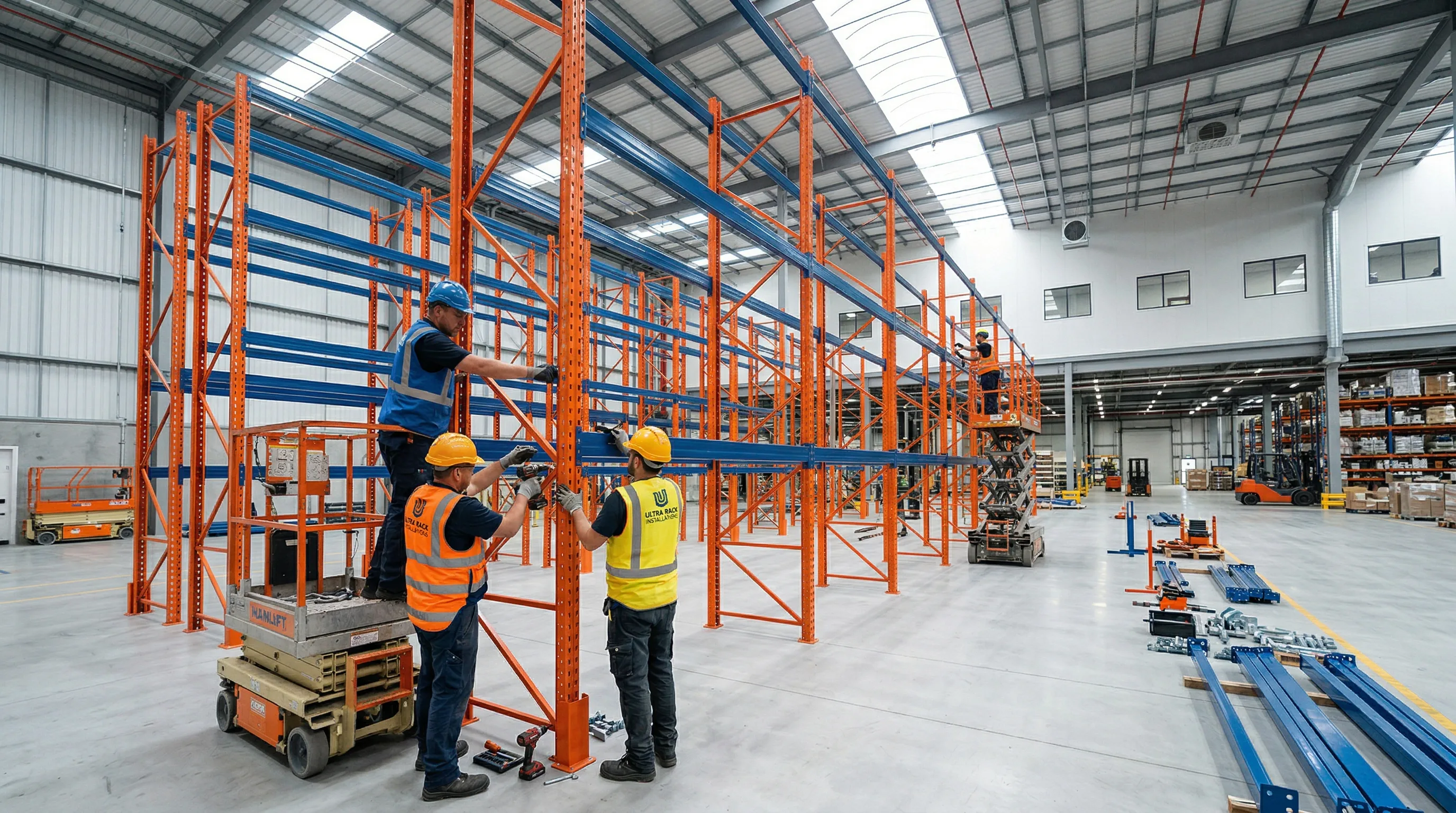
The Three Aisle Width Categories — and What They Actually Mean
Warehouse aisles are broadly categorized into three types, each requiring different equipment and producing different storage density outcomes:
Wide Aisle (11–13 feet)
Wide-aisle layouts accommodate counterbalanced forklifts — the most common type in use across the DC Metro area. These are the sit-down or stand-up forklifts you see in most warehouses. Wide aisles are the easiest to operate in, the cheapest equipment to buy and maintain, and the most forgiving for less experienced operators. The tradeoff is storage density: wide-aisle layouts typically use 40–50% of a building's footprint on aisles rather than storage.
Narrow Aisle (8–10 feet)
Narrow-aisle layouts require reach trucks or turret trucks. Reach trucks extend their forks forward to place pallets into the rack, allowing the machine to operate in a tighter turning radius. Narrow-aisle storage can increase pallet capacity by 25–40% in the same building footprint compared to wide-aisle layouts. Equipment costs are higher (a new reach truck runs $25,000–$45,000 compared to $15,000–$25,000 for a comparable counterbalanced forklift), and operators need more training and a flatter, more consistent floor.
Very Narrow Aisle (5–6 feet)
VNA systems use man-up turret trucks or specialized swing-reach equipment that can access both sides of the aisle from a single position. Aisle widths as tight as 5.5 feet are achievable. Storage density approaches the theoretical maximum for a given building. VNA equipment is expensive ($50,000–$100,000+), requires guide rails or wire guidance systems embedded in the floor, and demands very flat, consistent concrete — a constraint that rules out many older DC Metro industrial buildings without slab remediation.
OSHA Minimum Aisle Width Requirements
Regardless of what your equipment and storage strategy require, federal OSHA establishes minimum aisle widths that cannot be compromised:
- Aisles where mechanical handling equipment (forklifts) operates must be at least 3 feet wider than the widest vehicle or load being handled (29 CFR 1910.22)
- Permanent aisles must be appropriately marked — typically with painted yellow lines on the floor
- Pedestrian aisles must be at least 28 inches wide and clearly separated from forklift travel areas
In practice, the "3 feet wider than the widest load" rule means a standard 48-inch pallet on a standard counterbalanced forklift requires a minimum of about 10–11 feet of clear aisle width for safe operation. Most operators target 11–12 feet for wide-aisle counterbalanced operations as a comfortable working width.
DC Metro Building Stock: What You're Actually Working With
The DC Metro area has an unusually diverse mix of industrial building stock, and the building you're in may constrain your aisle options more than any other factor.
- Northern Virginia (Chantilly, Sterling, Dulles corridor): This is the newest and most logistics-friendly industrial stock in the region. Buildings from the 1990s onward typically feature 30–36-foot clear heights, 60×60 foot column spacing, and flat slabs suitable for narrow-aisle or VNA operations. Reach truck and even VNA layouts are practical in most of these buildings.
- Suburban Maryland (Landover, Jessup, Gaithersburg corridor): Mixed vintage. Newer buildings along I-95 in Jessup and the Route 1 corridor are comparable to NoVA. Older stock in Landover and Bladensburg — much of it built in the 1960s–1980s for federal government use — typically has lower clear heights (18–24 feet), tighter column spacing, and floor slabs that may need evaluation before VNA equipment is considered.
- Washington DC proper: Almost no purpose-built modern warehouse space. Facilities in Ivy City, Buzzard Point, and the northeast industrial corridor are predominantly converted industrial buildings with low clear heights, limited column spacing, and older floor slabs. Wide-aisle operations with counterbalanced forklifts are typically the only practical choice.
- Prince William and Stafford counties (southern NoVA): Growing logistics development along I-95 south of Manassas. Newer spec buildings are well-suited for narrow-aisle layouts, though the market is less mature than the Dulles corridor.
How Aisle Width Affects Rack Configuration
The aisle width you commit to determines more than just how wide the aisle is — it shapes the entire rack layout:
- Rack depth — single-deep vs. double-deep racking. Double-deep racking (two pallets deep, requiring a reach truck with extended forks) increases storage density but reduces selectivity. The aisle required between double-deep rows is similar to narrow-aisle single-deep.
- Bay width — bay widths of 8–10 feet are standard for two-pallet-wide bays. Wider bays can reduce the number of uprights and lower cost, but increase beam spans and reduce per-beam capacity.
- Cross-aisle frequency — very long rack runs require cross aisles for fire egress and operational efficiency. The International Fire Code (adopted in DC, Maryland, and Virginia) sets maximum rack run lengths before a cross aisle is required — typically 300 feet, though local amendments vary.
- End-of-aisle space — forklifts need turning space at the ends of aisles. For wide-aisle counterbalanced forklifts, this is typically 12–14 feet. For reach trucks, 8–10 feet. Failing to account for turning radius at design time is one of the most common layout mistakes we see.
Fire Code Implications for Aisle Width in DC Metro
Aisle widths in warehouses are also governed by the fire code, which adds another layer of requirements beyond OSHA and operational needs. The International Fire Code (IFC), adopted in Maryland and Virginia with local amendments, requires:
- Minimum 8-foot main aisles in high-piled storage (storage over 12 feet high)
- Minimum 4-foot cross aisles at 100-foot intervals in some configurations
- Additional clearances around sprinkler heads when top-of-rack storage exceeds certain heights
In DC proper, the DC Construction Code (based on the IBC/IFC) applies with DC-specific amendments. Facilities undergoing new rack installations in DC typically require a building permit, and the design must comply with the fire code as part of the permit review. Our Washington DC warehouse design team navigates these requirements routinely.
Calculating the Real Cost of Aisle Width Choices
The financial impact of aisle width decisions is significant and often underestimated. Consider a 50,000 square foot warehouse:
- A wide-aisle layout might yield 3,500–4,000 pallet positions
- A narrow-aisle layout in the same building can yield 4,500–5,500 pallet positions
- At $15–20/month per pallet position in a leased DC Metro 3PL operation, that 1,000–1,500 additional pallet positions is worth $15,000–$30,000 per month in revenue potential
Set against the incremental cost of reach trucks over counterbalanced forklifts, narrow-aisle layouts typically pay back within 12–24 months in facilities with consistent high utilization. Our warehouse design and space planning service includes a full density analysis comparing layout options so you can make this decision with real numbers — not guesses.
Getting Your Aisle Width Right the First Time
The best time to optimize aisle width is before the first rack bolt is tightened. Retrofitting a wide-aisle layout to narrow-aisle after the fact requires relocating every upright, reordering new beams, potentially resurfacing the floor, and buying new equipment. In our experience across DC Metro facilities, that process costs 60–80% of a new installation.
DC Pallet Racking's design team works with your building drawings, existing equipment list, and throughput requirements to develop an aisle width strategy that maximizes density without compromising safety or operations. Call us at (240) 540-4372 to discuss your facility.
Plan Your Warehouse Layout
Our design team creates optimized aisle and rack layouts for warehouses across Washington DC, Northern Virginia, and suburban Maryland. Free consultation available.
Get a Free Layout ConsultationReady to Optimize Your Warehouse?
Get a free estimate from DC Metro's warehouse racking experts. We serve warehouses of all sizes throughout the Washington, DC metro area.