Cold Storage Pallet Racking in the Washington DC Metro Area
10 min read · May 2026 · DC Pallet Racking Team
Cold storage warehouse racking is not the same as standard dry warehouse racking — and the differences matter. Temperature extremes affect steel performance, condensation cycles accelerate corrosion, NFPA 13 requires specific flue configurations in refrigerated environments, and DC Metro jurisdictions each have their own fire suppression review processes for cold storage facilities. This guide covers what operators in the DC, Maryland, and Northern Virginia cold storage market need to know.
Cold Storage Expertise
DC Pallet Racking installs and inspects cold storage racking throughout the DC Metro area, including galvanized systems and in-rack sprinkler coordination. For refrigerated and freezer warehouse projects, call (240) 540-4372 for a free consultation.
How Temperature Affects Steel Racking Performance
Steel racking is designed to perform within a standard temperature range, and cold storage environments introduce stresses that standard specifications don't account for. Key thermal effects on pallet racking include:
- Thermal contraction: Steel contracts as temperatures drop. In freezer environments (0°F to -20°F), dimensional changes in long rack runs can accumulate enough to stress connections and anchor points if not accounted for in the design.
- Steel ductility reduction at low temperatures: Carbon steel becomes more brittle at freezer temperatures. Cold storage racking should use steel with appropriate minimum impact strength ratings for the operating temperature range.
- Condensation cycling: In refrigerated (above 32°F) environments, daily temperature swings as dock doors open and close create condensation cycles that accelerate corrosion on unpainted or inadequately coated steel surfaces.
- Ice loading: In freezer environments, frost and ice accumulation on rack components is a real operational concern. Ice buildup on beams and uprights can affect load capacity and visual inspection ability.
These factors are why cold storage racking specifications differ from standard warehouse racking — and why working with a contractor who understands cold storage environments matters.
Galvanized vs. Painted Rack in the DMV Climate
The surface finish specification is one of the first decisions in a cold storage racking project. The two main options are hot-dip galvanized (HDG) steel and standard powder-coated painted rack. In the DC Metro climate, the choice depends on the specific environment:
Hot-Dip Galvanized (HDG)
- Best for freezer environments and high-humidity cooler applications
- Zinc coating bonds metallurgically to the steel — won't chip or peel under condensation cycling
- Higher upfront cost (typically 20–35% premium over painted rack)
- Lower lifetime cost in corrosive environments — significantly longer service life
- Required by some operators and health departments for food-grade cold storage
Powder-Coated Painted Rack
- Standard for ambient and mild refrigerated environments
- Lower upfront cost
- Adequate for cooler environments (35°F–55°F) with limited condensation exposure
- Surface coating can be damaged by forklift impacts — chips and cracks create corrosion initiation points
- Not recommended for freezer environments or facilities with daily condensation cycling
In the DC Metro region specifically, the combination of humid summers and cold winters creates aggressive condensation cycling in refrigerated facilities. For any application involving true refrigeration (below 45°F) or freezer storage, galvanized rack is the right specification. For slightly cooled or temperature-controlled storage (45°F–60°F), powder-coat can be adequate if damage inspection and touch-up maintenance are part of the operational protocol.
NFPA 13 Flue Space Requirements in Cold Storage
NFPA 13 (Standard for the Installation of Sprinkler Systems) governs sprinkler design for warehouses, and cold storage applications have specific requirements that affect how racking is configured:
- Longitudinal flue spaces: NFPA 13 requires continuous flue spaces in the direction of rack depth to allow heat and water from ceiling sprinklers to penetrate to lower storage levels. In cold storage, these flue spaces are particularly important because temperature gradients can affect heat rise patterns.
- Transverse flue spaces: Flue spaces across rack bays (between pallet positions) help ceiling sprinklers reach the mid-levels of storage. Cold storage racking layouts must maintain these spaces even when operators prefer tighter configurations for space efficiency.
- In-rack sprinklers: For cold storage above certain heights, NFPA 13 may require in-rack sprinklers to supplement ceiling systems. This requires coordination between the racking engineer and the fire protection engineer early in the design process — not after the layout is finalized.
- ESFR systems in cold storage: Early Suppression Fast Response (ESFR) sprinklers are common in modern DC Metro warehouses. In cold storage environments, ESFR systems require careful engineering to ensure response times are maintained at lower ambient temperatures.
The practical implication: your rack layout must be coordinated with your fire protection system from the start. Changing the rack configuration after fire protection engineering is complete can invalidate the sprinkler design and require re-engineering.
DC Metro Cold Storage Submarkets
The DC Metro area has several established cold storage submarkets, each with distinct facility characteristics:
Landover / Upper Marlboro (Prince George's County, MD)
The Landover area along the I-495 / I-95 interchange is home to a significant concentration of food distribution facilities serving the DC metro market — including refrigerated and frozen food distribution centers. Buildings here range from mid-century cold storage facilities with lower clear heights to newer purpose-built refrigerated warehouses. The older building stock often requires racking solutions designed around ceiling height limitations and irregular column grids.
Jessup / Laurel (Howard and Anne Arundel Counties, MD)
The Jessup distribution corridor — roughly along Route 1 between Laurel and the Route 175 interchange — serves as one of the Mid-Atlantic's primary food distribution hubs. Multiple national and regional food distributors operate refrigerated facilities here. The submarket benefits from its equidistant position between Baltimore and Washington, and cold storage racking in Jessup facilities tends toward taller configurations given the newer building stock. Learn more about our work serving the Maryland suburban market.
Alexandria Waterfront / Potomac Yard (Virginia)
The Alexandria waterfront area retains some legacy cold storage and food distribution activity — notably at Potomac Yard and along the Route 1 corridor. Building stock here is older and tends toward lower clear heights. Racking in these facilities is often limited to single-level or two-level configurations, with emphasis on maximizing floor utilization rather than vertical storage.
Dulles / Chantilly Cold Storage
Air cargo operations at Dulles International include time-sensitive cold chain freight — pharmaceuticals, fresh flowers, seafood, and premium foods. Cold storage racking adjacent to Dulles tends toward flexible configurations that accommodate frequently changing lot sizes and mixed-commodity storage.
OSHA Cold Environment Requirements
OSHA has specific guidance for workers in cold storage environments that intersects with racking design and operational practices:
- Visibility considerations: Workers in PPE (insulated gloves, face shields, heavy outerwear) have reduced dexterity and peripheral vision. Racking aisles in cold storage facilities should be wider than OSHA minimums to account for reduced operator awareness.
- Forklift operation in cold environments: Battery-powered forklifts see reduced battery performance in freezer environments. This affects how frequently forklifts are serviced and swapped — which in turn affects traffic patterns in the facility. Account for battery exchange areas in your layout planning.
- Emergency egress: Cold storage facilities must maintain clear egress paths that are unobstructed even when fully loaded. This is particularly important in refrigerated facilities where lighting levels are sometimes lower than ambient warehouses.
- Load placard visibility: OSHA requires load capacity placards on all rack bays. In cold storage environments with condensation cycling, ensure placards are protected or laminated to remain legible.
Rack Inspection in Cold Storage Environments
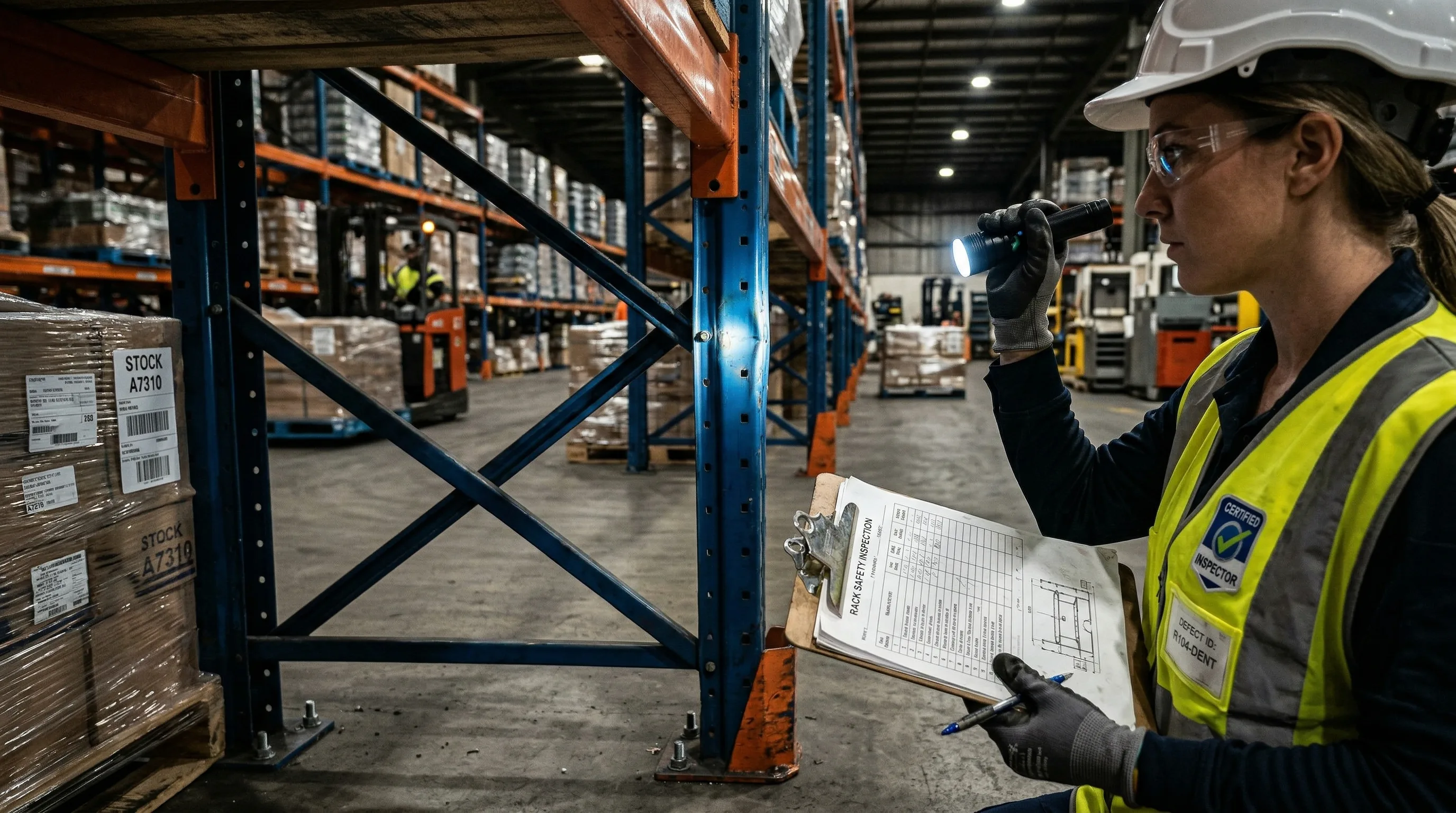
Cold storage racking requires more frequent inspection than ambient warehouse rack. The combination of condensation cycling, ice accumulation, and the reduced visibility that comes with worker PPE means that rack damage is both more likely to occur and easier to miss. We recommend:
- Quarterly formal inspections (versus annual for ambient warehouses)
- Post-winter inspection to identify any fatigue or damage from the heaviest condensation cycling period
- Annual inspection by a qualified racking engineer with cold storage experience
DC Pallet Racking performs professional rack inspections in cold storage environments throughout the DC Metro area, including written inspection reports suitable for OSHA documentation purposes.
Planning Your Cold Storage Racking Project
Cold storage racking projects require more upfront coordination than standard warehouse racking. The key to a smooth project is getting three workstreams aligned early: the racking layout, the fire protection engineering, and the permit process. Starting any one of these late creates a bottleneck that delays the others.
DC Pallet Racking coordinates all three workstreams for cold storage racking projects — rack design and engineering, fire protection coordination, and permit submission — so you don't end up managing three separate contractors and discovering conflicts at the last minute.
Cold Storage Racking in the DC Metro Area
We spec, install, and inspect cold storage racking throughout DC, Maryland, and Northern Virginia — including galvanized systems and in-rack sprinkler coordination. Call (240) 540-4372 to discuss your project.
Get a Free EstimateRelated Services & Areas
Ready to Optimize Your Warehouse?
Get a free estimate from DC Metro's warehouse racking experts. We serve warehouses of all sizes throughout the Washington, DC metro area.